What I wrote to teach, I leave here for parents to use.
Everything on this page is material I have used in my own drawing classes in Da Nang. I condensed it so a parent can read for a few minutes, then tell the story to a child, or try a small project together. Free to print at home; please don't resell it or republish it under another name.
The PDF below is currently in Vietnamese. The videos it links to are in English. An English edition is on my list.
“Very few artists are born with a style of their own. Most learn from those who came before, and combine what they learned.”
Art history, especially the art of other countries, can sound difficult. But when I began studying in the atelier tradition and looking closely at the old masters, I understood its value: to know the periods of art is to know what you can learn, and from whom. It is the same for a child. First they learn how one period, one master, saw the world; then they notice what they love; then they tinker and make something that is their own.
This first set covers Western art, because that is what I have studied and taught. From here I hope the children, and I, will go on to the art of our own country, Vietnam. I have not studied that nearly enough yet — it is a wish, not something I have done.
- It plants curiosity. When a child learns that Stone Age people painted with charcoal and earth, that Egyptians drew faces in profile, that medieval painters laid gold behind their figures, the child asks “why?”. Curiosity comes before technique.
- It grows a personal style. Learn how the masters looked → notice what you love → tinker until it becomes yours. No copying model pictures, no memorising dates.
- Then back to Vietnamese art. Understanding how the world has looked, so that one day we can look at our own folk paintings and ethnic patterns with eyes that know how to value them.
A 13-week journey through art history
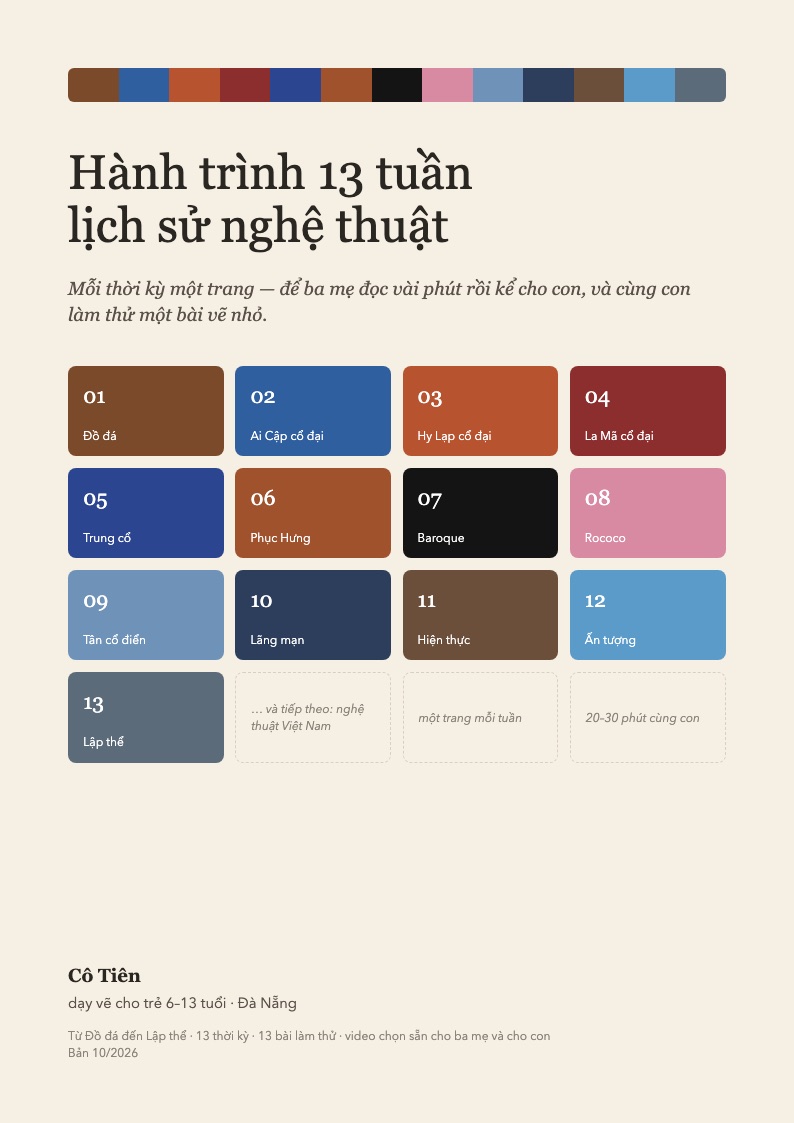
One period, one A4 page, for a parent to tell a child.
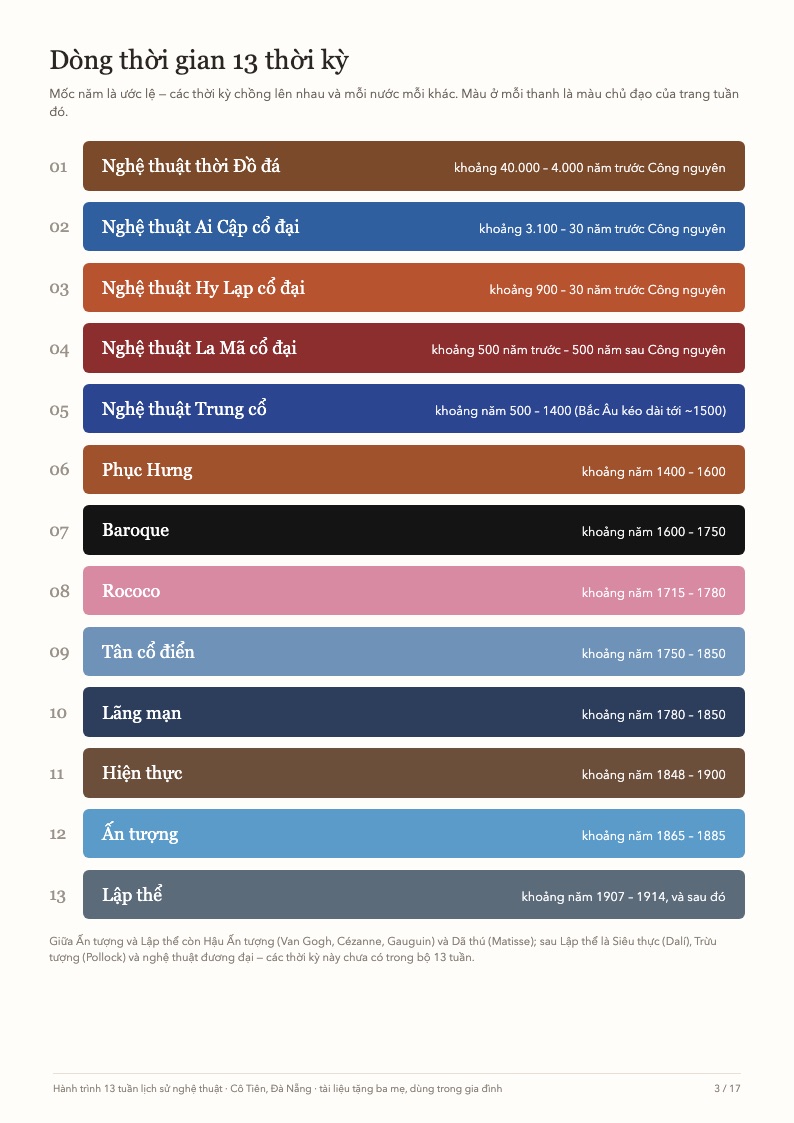
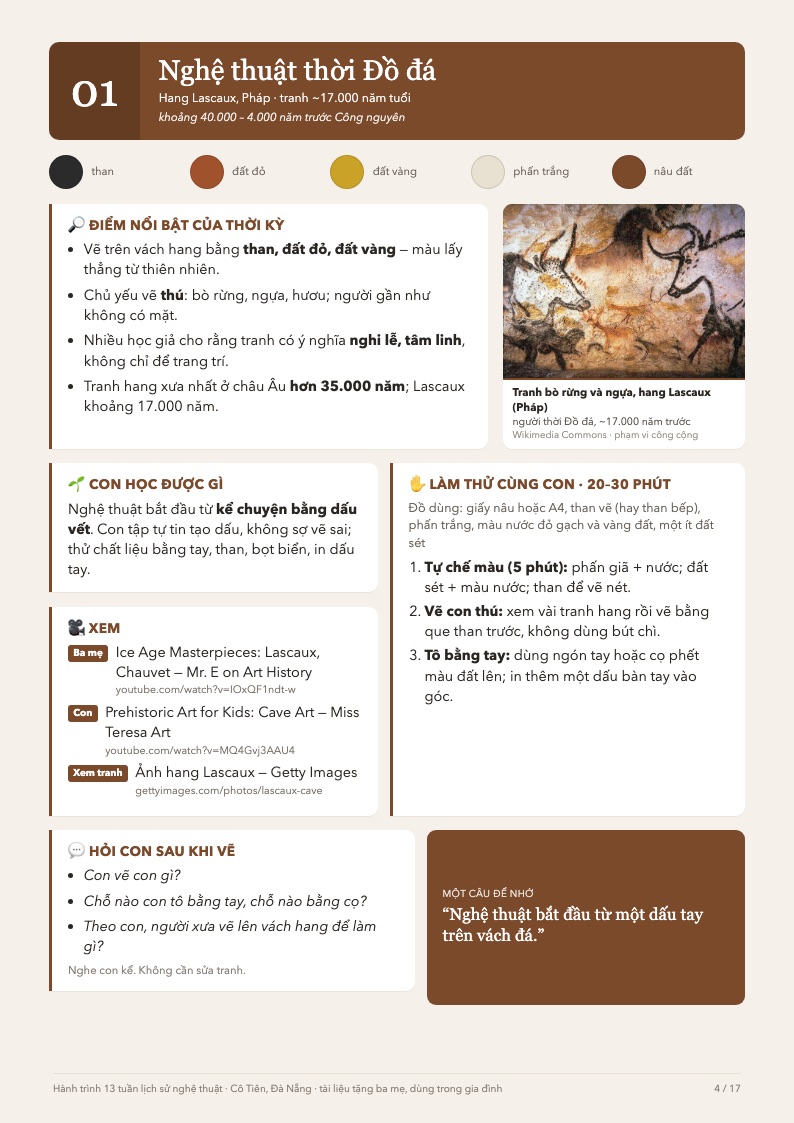
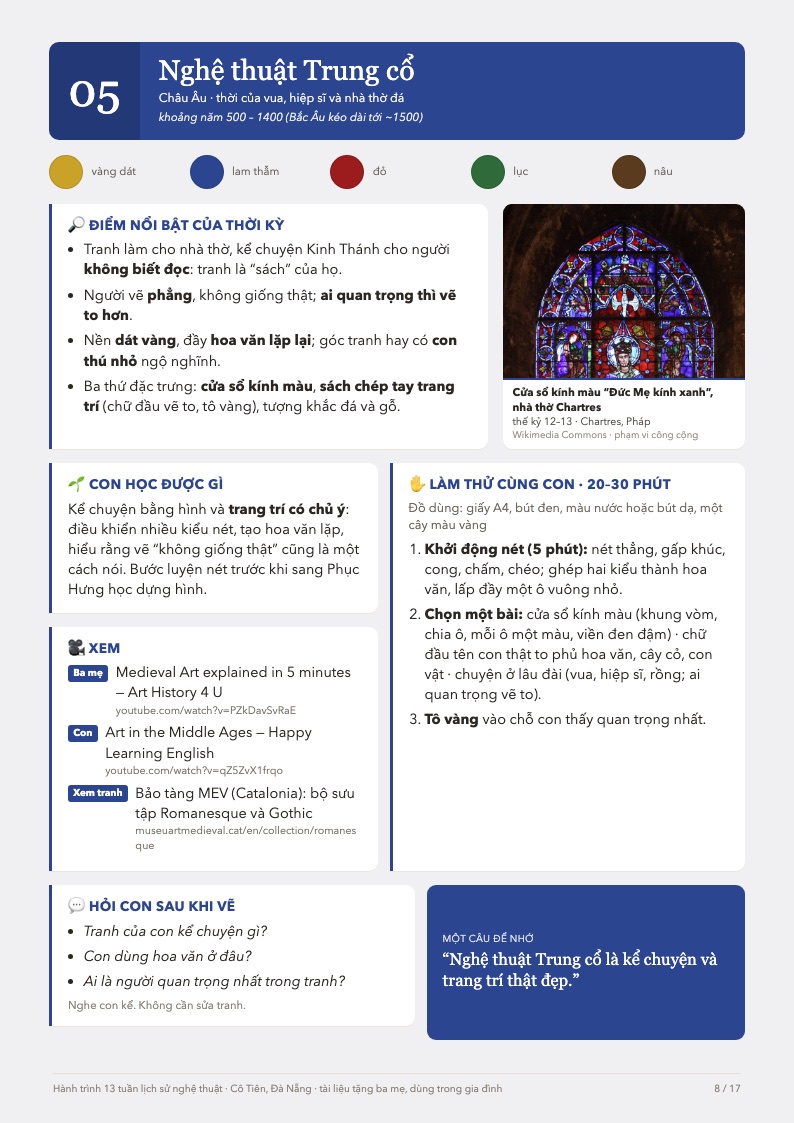
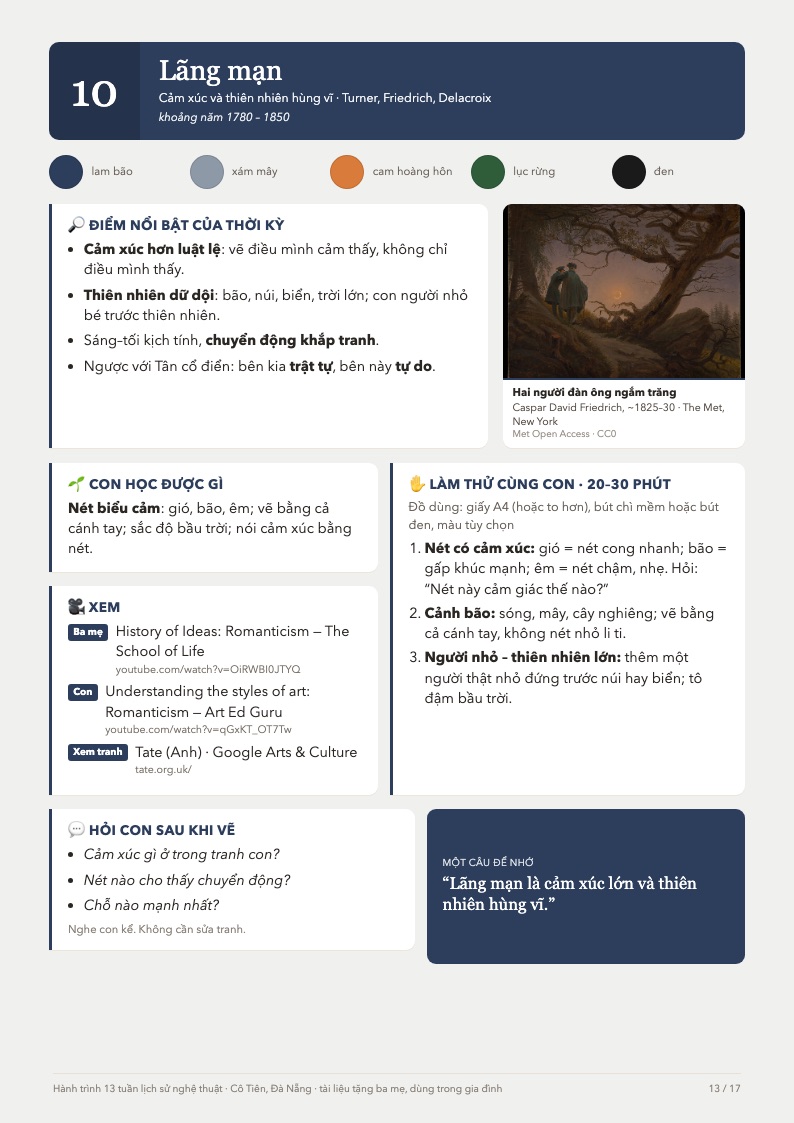
From Stone Age caves to Cubism: thirteen periods, each on a single page with what stands out, what the child learns from it, one video for the parent, one for the child, and a 20–30 minute project to try together with things you already have at home. This is the curriculum I wrote and taught in my class, up to week ten.
- 17 A4 pages, colour or black-and-white
- 13 projects to try with a child
- One public-domain artwork per page
- Clickable video links inside the PDF
- A shared timeline of all 13 periods
- A five-colour palette for each period
The videos belong to other YouTube channels. Your child doesn't need to copy anything — only to look, to ask, and to try.
Click an image to enlarge.
I'm still working.
These three are at different stages — I label them honestly so nobody waits for the wrong thing. New releases are announced on Facebook.
An upside-down drawing and colouring set — to wake up visual thinking
You draw from an image turned upside down: you look at lines and shapes instead of remembering “what this thing looks like”, then colour it in. A way to train the eye, for parents and children from 10. I am still writing it; no release date yet.
Drawing from the roots — for parents of 6–13 year olds
Form, proportion, light and shade, in the order I teach them in class, rewritten for parents to do at home.
Vietnamese art for children
Folk paintings, ethnic patterns, craft traditions. I haven't studied enough to write this yet — it is the direction I want to go, not a promise.
Questions, corrections, or a drawing your child made: message me on Facebook. I'd love to hear.